
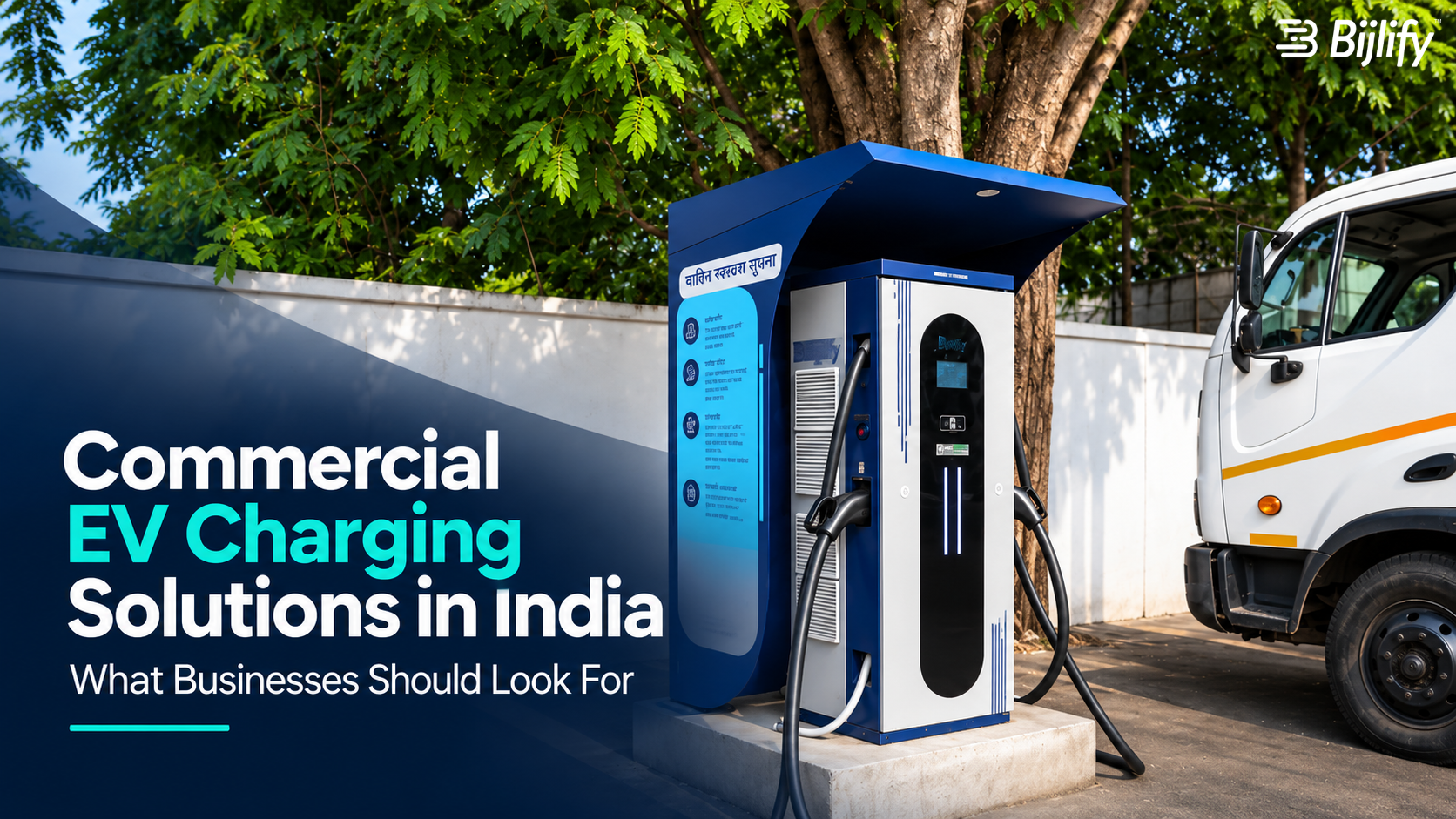
Introduction: Planning EV Charging for Commercial Properties
Electric vehicles are changing the way businesses think about parking, infrastructure and the experience they offer employees, visitors and tenants. For commercial property owners and facility managers, EV charging is becoming an infrastructure consideration that requires careful planning.
Installing EV chargers in business premises involves multiple assessments apart from selecting equipment. Some of these include electrical capacity, parking arrangements, expected charging demand, software requirements, maintenance and the potential to expand as adoption grows.
The right commercial EV charging solution has to address these requirements while fitting the property's operational needs and budget.
Bijlify offers EV charging solutions for commercial applications, combining charging hardware, software and service capabilities to support businesses planning and managing charging infrastructure.
1. Identify the Right EV Charging Solution for Your Property
Different commercial properties have different charging requirements. An office campus where vehicles remain parked for several hours has different needs from a business location where faster vehicle turnaround is important.
AC chargers for workplace parking
AC chargers can be suitable for office campuses, IT parks and business properties where vehicles remain parked for extended periods. Employees, tenants and visitors can charge while carrying out their regular activities, subject to vehicle compatibility and the available electrical infrastructure. These can be converted into public EV charging stations or used specifically with restricted access for employees and other related premise staff.
DC chargers for faster charging requirements
DC chargers can be appropriate where vehicles need to recharge more quickly, depending on vehicle capabilities and the power available at the site. They may be considered for selected commercial locations with higher charging demand or shorter parking durations.
Plan around actual usage
Before choosing the charger configuration, assess:
- The number and types of vehicles likely to use the facility.
- Expected charging demand and parking duration.
- The number of vehicles that may charge simultaneously.
- Available electrical capacity and any required upgrades.
- Space for charger installation, parking and safe vehicle movement.
- Scope for adding chargers as demand increases.
A site assessment helps businesses select infrastructure that matches their requirements rather than investing in capacity that may not be needed.
2. Make Charging Infrastructure Easier to Manage
For commercial properties, installing chargers is only the first step. Facility managers also need visibility into charger operations, charging activity and user access.
Bijlify's Charge Point Management System (CPMS) can help operators manage compatible charging stations through a centralized platform. Depending on the system and configuration, capabilities may include charger monitoring, user management, transaction records and operational reporting.
These functions can be useful when managing multiple chargers or installations across different locations.
When evaluating a solution, commercial buyers should ask:
- Can charger status be monitored remotely?
- How are users authorised to access charging?
- What transaction and utilisation information is available?
- How are faults identified and escalated?
- Which software services and updates are included?
- What support is available when charging equipment experiences problems?
The objective is to choose a solution that fits the property's operating model and gives the responsible team appropriate oversight of the infrastructure.
3. Understand the Total Cost of Commercial EV Charging
The cost of commercial EV charging infrastructure extends beyond the price of the charger.
Depending on the site, the investment may include equipment, electrical upgrades, civil works, installation, connectivity, software, maintenance and technical support. These costs should be considered together when comparing suppliers.
Before finalising a proposal, businesses should establish:
- The equipment and installation costs.
- Whether electrical and civil work is included.
- Any recurring software, cloud or service charges.
- Warranty coverage and exclusions.
- Preventive maintenance and technical support arrangements.
- Costs associated with future expansion.
Consider the operating model, not just the purchase price
Bijlify's Zen Bundle is a consumption-based offering designed to combine charging infrastructure with services such as CPMS, cloud support, software updates and maintenance under the applicable commercial terms.
For eligible deployments, this model provides an option to evaluate against arrangements with separately charged recurring software licence fees. Businesses should review the specific commercial proposal to understand the services included, applicable warranty, exclusions and contractual conditions.
A like-for-like comparison helps commercial property owners understand the financial and operational implications of each option.
4. Plan for Scalability and Long-Term Requirements
Commercial properties may experience changing EV charging demand as more employees, tenants and visitors adopt electric vehicles. Infrastructure planning should therefore consider both current requirements and potential future needs.
A scalable approach begins with understanding the property's electrical capacity, available parking, expected demand and the practicalities of adding charging points later.
Businesses should discuss:
- Can the charging system be expanded as demand increases?
- What electrical upgrades may be required with the demand increase?
- Can the software platform scale to accommodate the additional chargers?
- Do the proposed layouts support safe and convenient access?
- How do maintenance and support arrangements accommodate expansion?
Planning ahead can help avoid unnecessary redesign and make future infrastructure decisions more straightforward.
5. Evaluate the Supplier's Capabilities and Support
Commercial EV charging is an infrastructure decision, not simply an equipment purchase. The supplier's ability to support the installation after commissioning is an important part of the evaluation.
Before selecting a partner, clarify the responsibilities for installation, commissioning, troubleshooting, preventive maintenance and technical support. Understand the applicable response commitments and how faults will be managed.
It is also worth asking about charger compatibility, software capabilities, warranty terms and experience with similar commercial applications.
When reviewing project references, look for installations relevant to the type of property being developed or managed. Ask about the scope of the deployment and the capabilities delivered, and seek substantiated operating information where available.
A structured evaluation helps businesses compare suppliers on the overall solution, not just the equipment quotation.
Why Consider Bijlify for Commercial EV Charging?
Bijlify provides EV charging solutions for commercial properties, including office campuses, IT parks and business parks.
Its offering combines AC and DC charging hardware with charging management software and service capabilities. The appropriate configuration depends on the site's electrical infrastructure, vehicle requirements, expected charging demand and operational objectives.
For businesses evaluating ownership and operating models, Bijlify's Zen Bundle offers a consumption-based option, subject to the agreed commercial terms.
Commercial property owners and facility managers can assess Bijlify against their project requirements, including charger selection, site planning, software, maintenance and long-term operating costs.
The aim is to identify a charging solution that works for the property today and can accommodate its requirements as they evolve.
EON IT Park case study
EON IT Park, one of the prominent IT parks in Pune's Kharadi area, set up a Bijlify EV charging station at its inception. The destination now charges around 200 EV vehicles per month and has become a model set-up for IT parks across Maharashtra.